Hankook Pushes the Limits on High-Speed Forest Stages at WRC Delfi Rally Estonia 2026
- Round 9 of the 2026 WRC, Delfi Rally Estonia, takes place from July 16 to 19 in Tartu and the surrounding southern regions
- Dynapro R213 all-terrain rally tire supplied to tackle lightning-fast unpaved surfaces and airborne jump sections
- Championship battle intensifies as fierce competition is expected on ultra-high-speed gravel stages
TARTU, Estonia, July 15, 2026 /PRNewswire/ -- A leading global tire company Hankook Tire & Technology (Hankook), the exclusive tire supplier to the FIA World Rally Championship (WRC), heads to Round 9 of the 2026 WRC, Delfi Rally Estonia, taking place from July 16 to 19 in Tartu and the surrounding southern regions of Estonia.
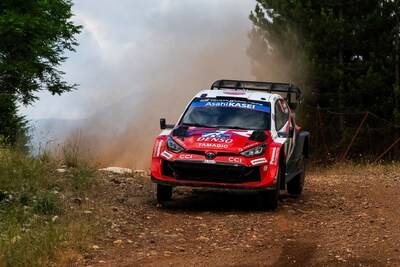
Delfi Rally Estonia is Estonia's largest motorsport event, centered around Tartu, the country's second-largest city. The rally kicks off with a ceremonial start at Tartu City Hall Square, before competition unfolds across ultra-high-speed gravel tracks. Renowned for its high-speed gravel stages, Delfi Rally Estonia is widely regarded as one of the fastest rounds on the WRC calendar.
The 2026 edition spans 18 Special Stages (SS) across a total competitive distance of 301.8 kilometers. Wide, high-speed forest roads combine with narrow technical sections on loose surfaces, where average speeds regularly exceed 120 km/h. Rapidly changing surface conditions, a series of long airborne jumps, and sharp compression sections demand pinpoint vehicle control and maximum concentration at every moment throughout the stages.
In particular, 'Blind Crest' sections — where visibility beyond crests are completely cut off — demand split-second judgment and precise handling. Tire grip, durability, and stability at high speeds will be critical throughout the rally.
Hankook will supply its extreme all-terrain rally tire, the Dynapro R213, to support stable performance throughout the event. Engineered with outstanding shock absorption and durability, the tire delivers exceptional grip and handling even on rough off-road surfaces.
Available in Hard and Soft compounds to be deployed strategically based on surface conditions and weather, the Dynapro R213 ensures optimal steering stability even under repeated high-speed driving and airborne jumps. Through this performance in one of the WRC's fastest and relentless rallies, Hankook aims to demonstrate its advanced tire technology under one of the WRC's most demanding high-speed conditions.
At the previous round, EKO Acropolis Rally Greece, Sébastien Ogier claimed victory, firmly joining the battle for the Driver's Championship. Championship leader Elfyn Evans currently holds 162 points, just 11 ahead of second-placed Takamoto Katsuta on 151 points, keeping the competition tight as the standings could change with the outcome of each round.
Hankook serves as the exclusive rally tire supplier for all WRC classes, actively integrating driving data accumulated on the world's top motorsport stage into its R&D to drive high-performance tire innovation. Through this, Hankook continues to advance high-performance tire technology while strengthening the global reputation of the Hankook brand.

Photo - https://mma.prnewswire.com/media/3006093/Photo_1__2026_WRC_EKO_Acropolis_Rally_Greece___Toyota_GAZOO_Racing_World_Rally_Team.jpg
Logo - https://mma.prnewswire.com/media/2866236/Hankooktire_CI_Logo.jpg
 View original content:https://www.prnewswire.co.uk/news-releases/hankook-pushes-the-limits-on-high-speed-forest-stages-at-wrc-delfi-rally-estonia-2026-302825980.html